Commercial air travel remains something of a miracle. This tin can launching itself into the sky, full of people who maybe grew up dreaming of one day doing it. And those of us who did it for the first time as children. I’m not excited by flight, I find it calming. The same with trains. Once you’re on and seated, there’s nothing you can do but sit back and relax. Rachael and I are separated by virtue of refusing to pay for a seat seeing as we’ve paid to be on the plane. This also guarantees a middle seat. I catch glances out of the window of the infinite plateau of white clouds. Rivers of land form between islands of stiff white peaks. Sheets comparable to sand or ice stretch away to the horizon haze before rising in the wide open blue of sky above. How could I be anything other than impressed? The plane is too warm, the seat minimally cushioned, but being a small man at least I’ve got leg room. I doze for the first hour or so. Tired from life. The angle of Rachael’s head, 6 rows in front, suggests she too is asleep.
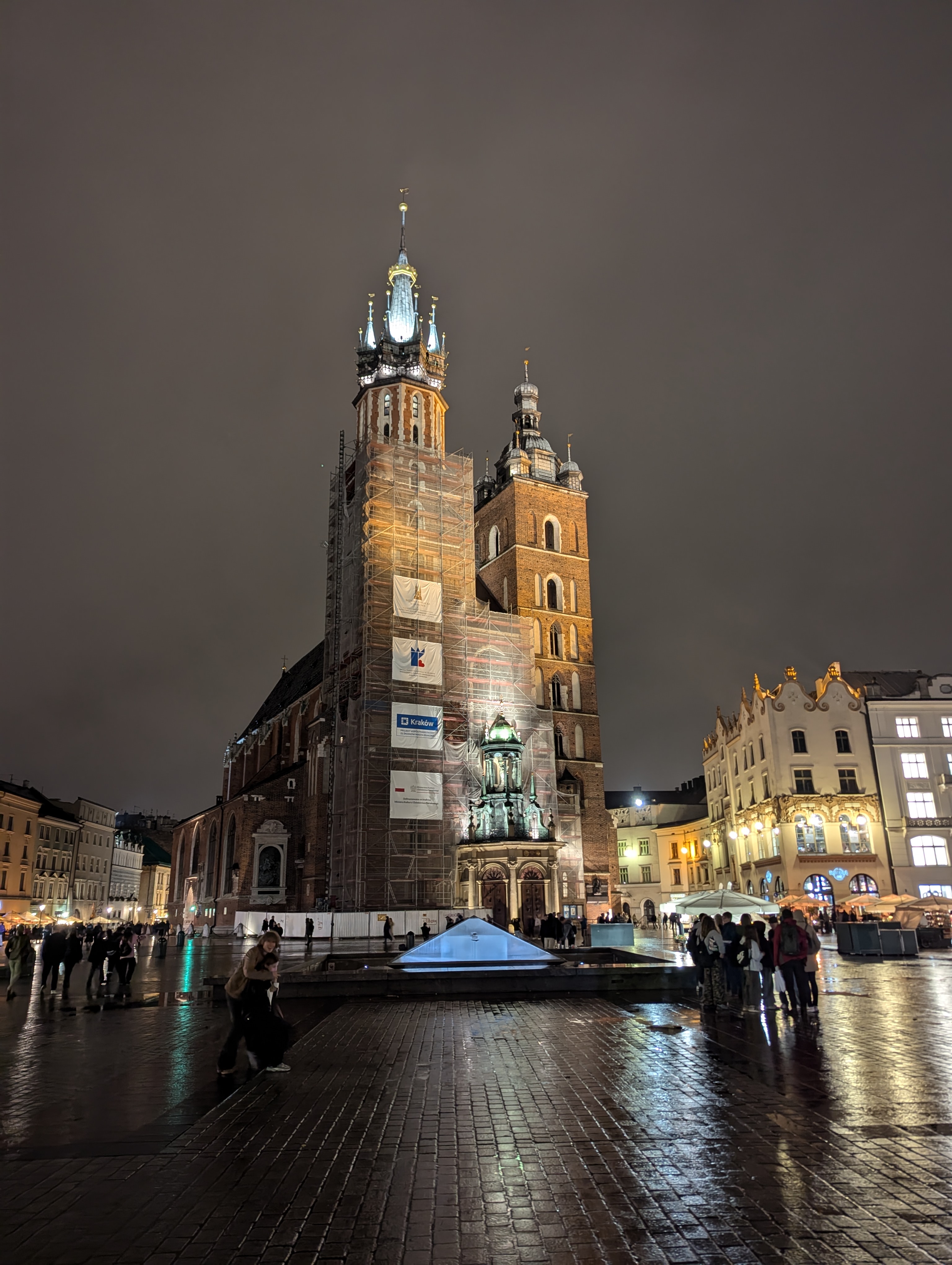
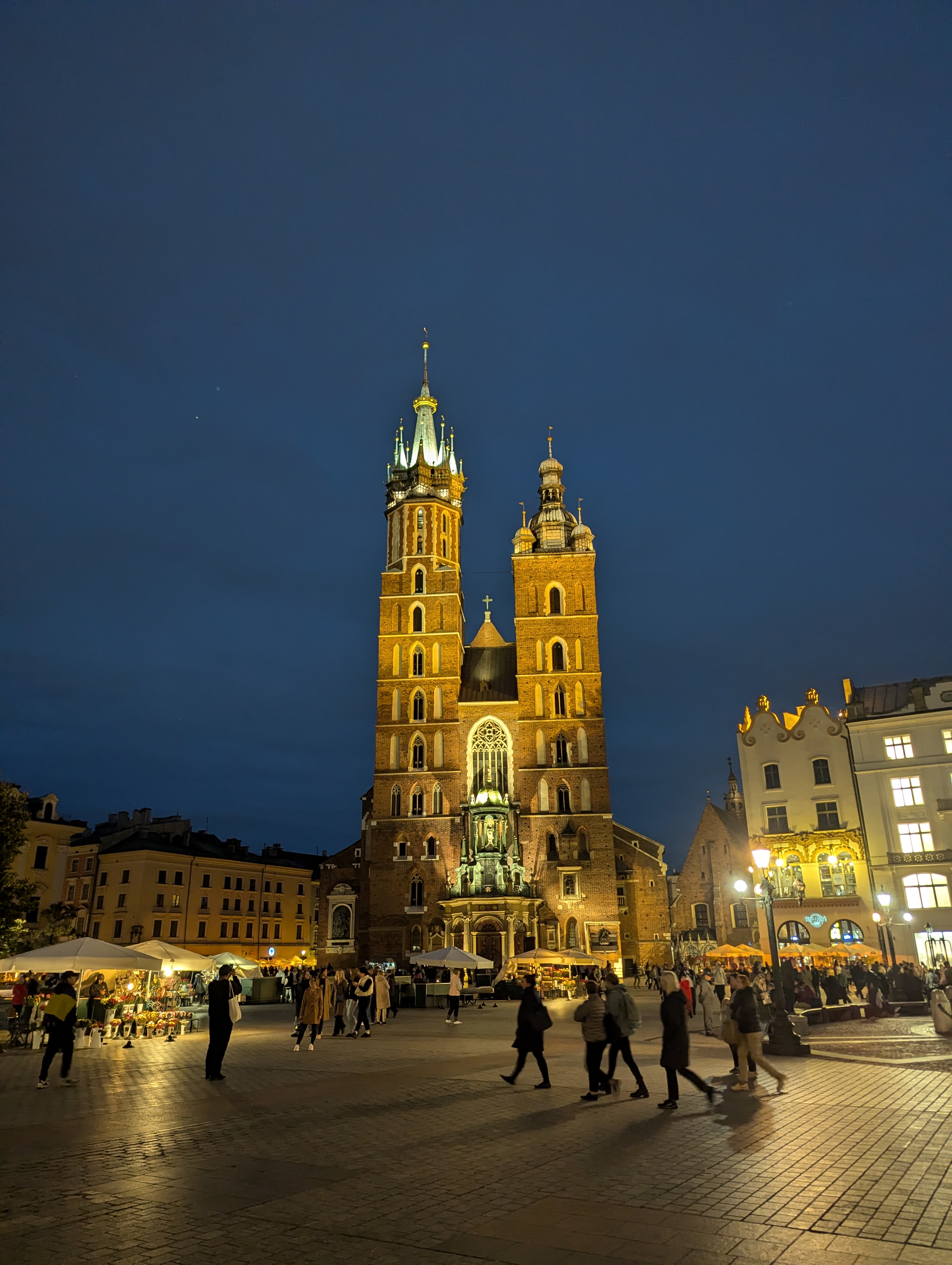
Rachael is in charge of the operation. She plots our journey from airport to AirBnB. A plan for the first pierogies of the trip. We head out, towards the old town; Stare Miasto. The grandeur of Europe’s old cities has never let me rest. Wide cobbled avenues split by tram lines. City lights sparkling in a thin coat of rain. Tall buildings with central courtyards. Mosaic tiled entries to staircases, where the wooden steps dip beneath centuries of footfall. High ceiling and big windows. Krakow reminds me of the last time I came to Krakow. Not that I remember much. The tower of St Mary’s basilica is wrapped in scaffolding. A trip to a European city isn’t complete if one of the major landmarks isn’t either. Rachael orders some ruskie and some studenckie pierogies from Przystanek Pierogarni. Potatoes and cottage cheese, and potatoes and bacon stuffed into tasty little dough pockets. We take a seat by the wall. Post-it notes have been sketched on, a child’s review of the food. Layer upon layer of blue, yellow, green, and pink. We grab a half a litre of craft beer from Multi Qlti before bed.

The holiday is a gift for me. I haven’t planned anything. I can’t speak the language. I just have to show up. Make the coffee in the morning before we set out. Rachael leads us to Szalej Cafe. She informs me this translates as go crazy. So I did. I went for sausages but I left having consumed life changing pea paste. Imagine smashed avocado, but more like mushy peas but also nothing like mushy peas. Is it horseradish? Lemon? Mint? The whole dish was delicious. The tiny sausage skin snapping in my teeth. Fatty, soft pork spilling in to my mouth. A whole loaf of tiny, fresh challa bread. Soft, delicate. The sort of breakfast I’d write home about. I notice there’s English on the walls. This becomes a constant theme as one culture slowly becomes normalised across the continent. Rachael questions how much harder it might have been to write the Polish word for coffee, which isn’t distantly removed; kawa.
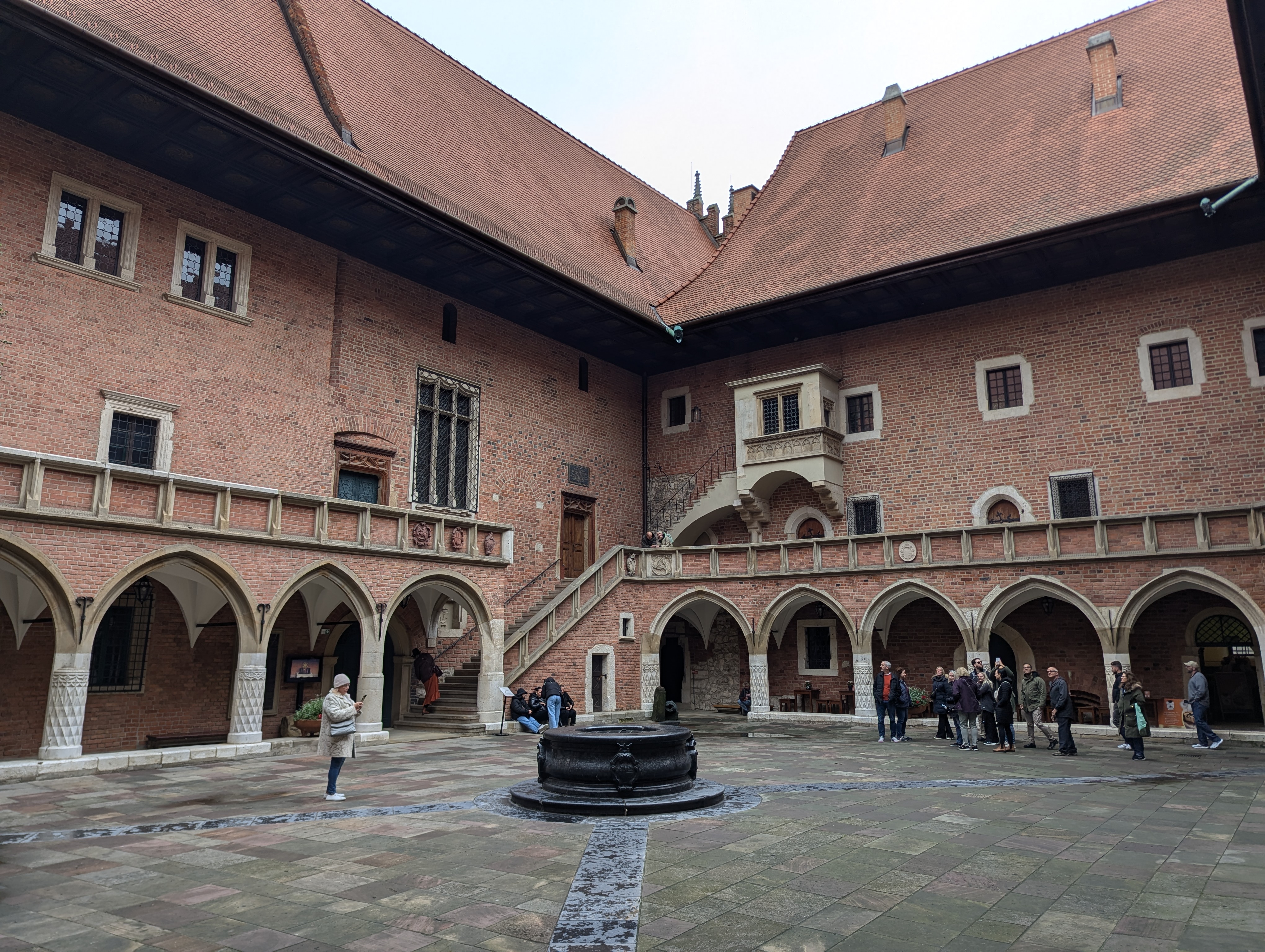
After food it’s time to explore. The city is vaguely familiar. We start at the Barbakan; old defense works, the last remains of the moat. Then we move centrally, again, to the Florian Gate, named for St Florian, patron saint of chimney sweeps of all things. Rachael must have Wikipedia open, she tells me he told the Romans he wasn’t afraid of being burned at the stake, so they tied a millstone around his neck and threw him in the river instead. We move through ugly magnet shops. Back to the square, under the roof of The Cloth Hall, where there are yet more sellers of ugly magnets. Rachael leads us out to the university. I think I’m already winding her up, asking at every male statue; “is that Copernicus?”. The university courtyard is magnificent. The copper drain pipes are the weirdest gargoyles I’ve ever seen. Dragons cut in to the metal. They remind me of those early self portraits that ended up on tea towels. The paving below is concave, where storm water must barrel off the steep red roofs. White limestone columns with black shards of flint, or fossils, support a terrace around the edge. We walk through a small park, where we find placards detailing the horror experienced, and also the solidarity, of professors arrested and imprisoned by the Nazis. Accounts follow of attempts to have them freed by global academia. Europe’s dark ages never feel far enough away.

We carry on, Southbound, towards the Wisla River, and Wavel Castle on the hill. Rachael and I both comment on the quantity and quality of massive doors along the way. At one male statue, who is clearly Pope John II, I have a revelation. “Is Papa John’s named after the former Pope?” I ask Rachael, and get my photo taken with the leader of shit pizza. Rachael points out a problem with this theory. This is Papa John the second. There was another, earlier father of cheese and tomato on toast. We climb up and around the castle’s walls and enter the courtyard. The cathedral at Wavel castle is also under construction. Krakow clearly isn’t ready for us. We don’t visit any of the major attractions, but Rachael does convince me to enter the Dragon’s Den. We descend a narrow, spiral staircase in to the hillside. We pass through three cave chambers. A section now closed to the public contains lakes, home to a rare crustacean, or is it a worm? We emerge to the famous statue of Smok, which is the most unhinged statue I’ve ever seen. Are those arms? Why do they look like heads? And of course, being a dragon, it breathes fire. This, at least, I do remember.

The first place Rachael suggests for lunch is queueing out the door. The place next door is almost empty and it’s like walking into someone’s living room. A man behind the bar doesn’t give Rachael any opportunity for English and she’s glad for the practice. I’ve got a list of things to try and today I’m keen for the zurek. A sour rye bread soup, with sausages, eggs, and potato. I’m prompted to ask when does soup become a stew? This can’t be far off. After food, we set off again into the old Jewish quarter of Kazimierz. Along the streets, the render is coming away from the buildings. Up to head height on the exposed brick walls is tagged in blue, black and purple. There’s a distinct lack of decent murals. For an area that was long abandoned, and left to rot, it doesn’t feel hipster enough. We wander about, and eventually drop in to Corpus Christi cathedral which is nice from outside but tacky within. So much gold leaf. Back outside I really am sold on what a beautiful building it is. The steep roof, the red brick. I’m a fan. We do another church. The St Francis Basilica. Outside is less impressive. Heavily rendered, regularly extended. This one feels more like a complex than a single house of worship. Stepping in, my eyes take a second to adjust. The church is lit only through light coming in through amazing stained glass windows and flickering prayer candles. The decorations on the walls are equally eye catching. Amazing wall decorations, stained glass windows. At the back, God is in the full act of creation. I can see why the Poles rate Stanislaw Wyspiański as a genius. There’s a lot less gold here too. Outside there’s the now standard scale bronze models of every landmark, with notably polished knobs where hands have always touched.
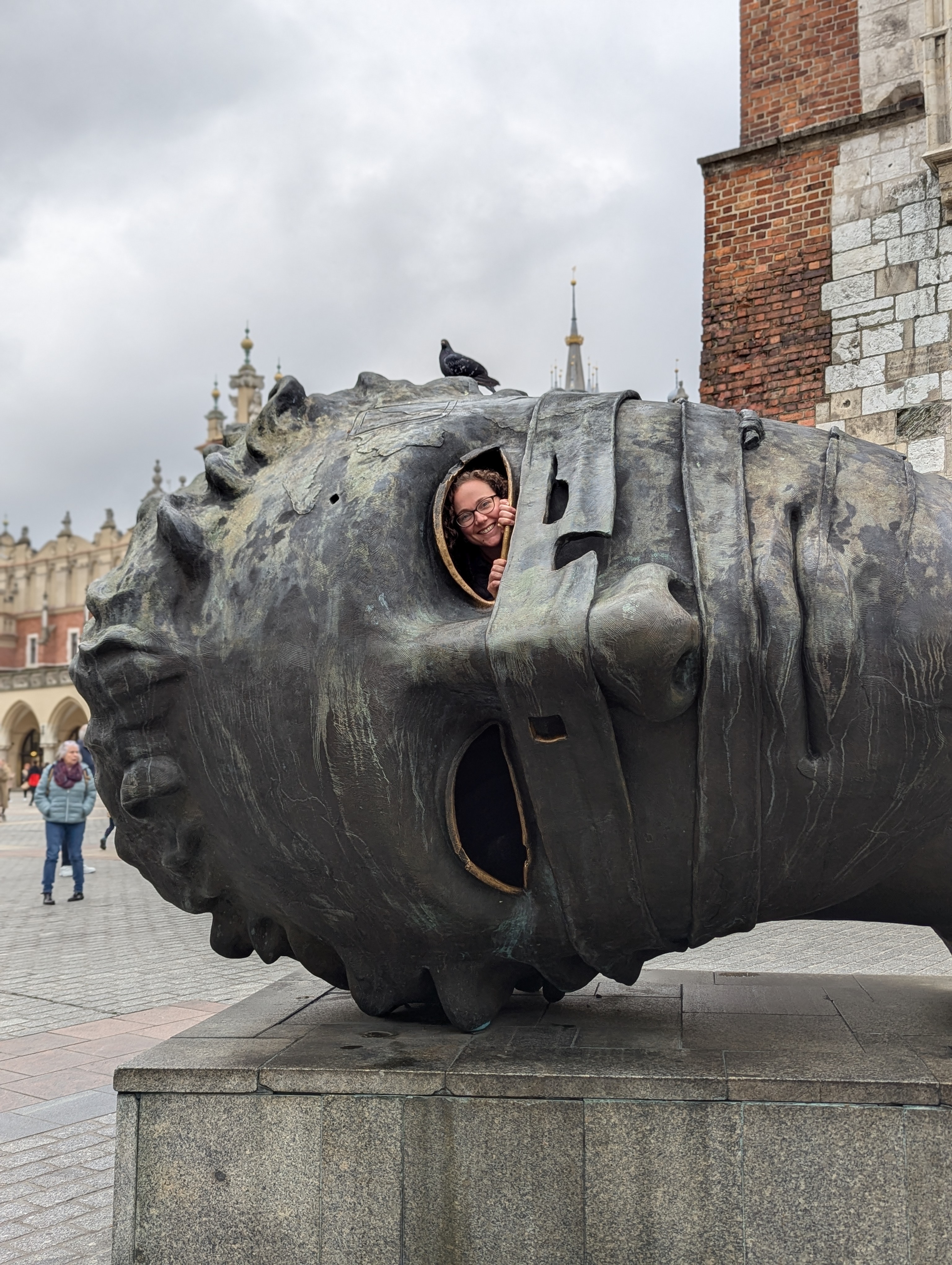
Back in Stare Miasto, Rachael gets in the bronze head of what should be, but isn’t Copernicus. By now she’s telling me everyone’s Copernicus, you’re Copernicus, we’re all Copernicus. I don’t bother to find out who it really is. For Rachael, this is throwing it back to her own Interrail trip. She’s even got a photo of this younger version of herself crawling out of the same copper eye slit. We head back to the university quad to watch the clock chime 5. A madness we planned our afternoon around, having been off beat on our earlier visit. 5 bongs and then eventually, after wondering if it was broken, a trail of wood carved figures cycle between two doors. A crowd has gathered to witness this. They print it in guidebooks. I probably wouldn’t have bothered. We decide one more basilica is too many, and as we have to pay to get in, I declare there isn’t time. We head back to our tiny apartment for a well deserved cup of tea and to research dinner. This time I go for a kotlet. What might you know it as? An escallop, a schnitzel, a pounded thin slice of meat fried in breadcrumbs. Mashed potato served in ice cream scoops on the side. Cabbage, to keep it Eastern. We walk around the square again, looking for somewhere to stop for a drink. I make a suggestion but Rachael wants a table outside, one with a fire burning. It’s Sunday night, compared to last night it’s quiet. Not many fires burning. Maybe another night? We slip into the bar I first pointed to and enjoy another half a litre.

There exists an awful human response to being on holiday. Rachael and I both shake our heads as we hear a woman tell her friends in Boomer English “there’s a Costa up the road, let’s just go there.” We’re sat in Fitagain Coffee & Food, munching through a sweet breakfast and a power breakfast. More sausages, more bread. There’s no reason to go to a Costa in the UK, let alone in a major cultural centre of Eastern Europe. Right to jail for you. After breakfast we’re looking for a map. There’s more stained glass in the tourist information by the same artist. King Casimir is depicted as a corpse, which is fitting seeing how he’s been dead for several centuries. Rachael grabs Poland’s answer to OS Maps for the High Tatras, so we’re at least prepared for a couple of days in the hills. Krakow bus station is something out of the 90s. I imagine the whole thing would be condemned were it in the UK. Poland’s public toilets are locked behind pay walls. In some of the bars and restaurants you have to ask someone for a key. You’d think being a paid up member of the EU would make this criminal behaviour impossible but here we are. Somehow the UK is outperforming the mainland on accessible toilets. Our bus slips out of Krakow along car dealership lined highways. Forested hills rise on the horizon, shimmering blue as they roll further away. I’m amazed to see elevators attached to most bridges we pass under. I guess this is a consequence of saving space with stairs. At some point they’re no longer accessible to an ageing population. The bus weaves and climbs. Rachael snoozing next to me. Through tree lined valleys we drive, until there, devoid of all details, a shattered ridge of broken teeth. Proper grown up mountains. My first sight of the High Tatras. I weave my head around the chairs and passengers, filling up on the jagged edge running across the sky before the bus drops into the next valley. In the town of Swiss style chalets and soviet blocks, Rachael points out a stork’s nest with a pair of huge white birds. There’s not much time for me to take it in, but when we come back out I decide they’re definitely plastic.

Zakopane sits at the foot of the High Tatra mountains. The cross on the summit of Giewont visible from all around. Of course, the best view was from on the bus, behind the windows. The town feels like a gateway to the mountains. Trees turning yellow. Wooden challets line the streets, from abandoned and definitely haunted to modern and chic in style. We grab hiking snacks from Lidl and jump on a local bus to our accommodation, deeper into the hills. Things are a bit of a farce on arrival. Check in at reception but there’s no obvious reception. A phonecall with a woman makes a boy appear who manages to show us to a room, which doesn’t look as advertised. There’s no mention of breakfast. Rachael does some Polish practice, asks again about the nearest shop, why the shower doesn’t have a bracket, and where do we go for breakfast. The shop is down the road, the shower has been removed from the wall because guests use too much water. Rachael laughs immediately, later she’ll use hair ties to string up the showerhead so we can wash in some comfort. Breakfast is in the main room from 8am til 9am, which is hardly crack of dawn hiking appropriate. Feeling more settled we return to town, walk the tat-lined high street before Rachael leads us to a typical traditional restaurant. Karczma Goralecska hides a crowd, upstairs and down. A three-piece boy band with double bass, violin, and accordion are belting out some Lesser Polish classic anthems. We’re pointed to a table and peruse the menu. I opt for pork knuckle and Rachael for the cutlet. The food is incredible, again. I’m pulling meat off the bone for 20 minutes. The beer is not bad either, and the price is unbelievable.
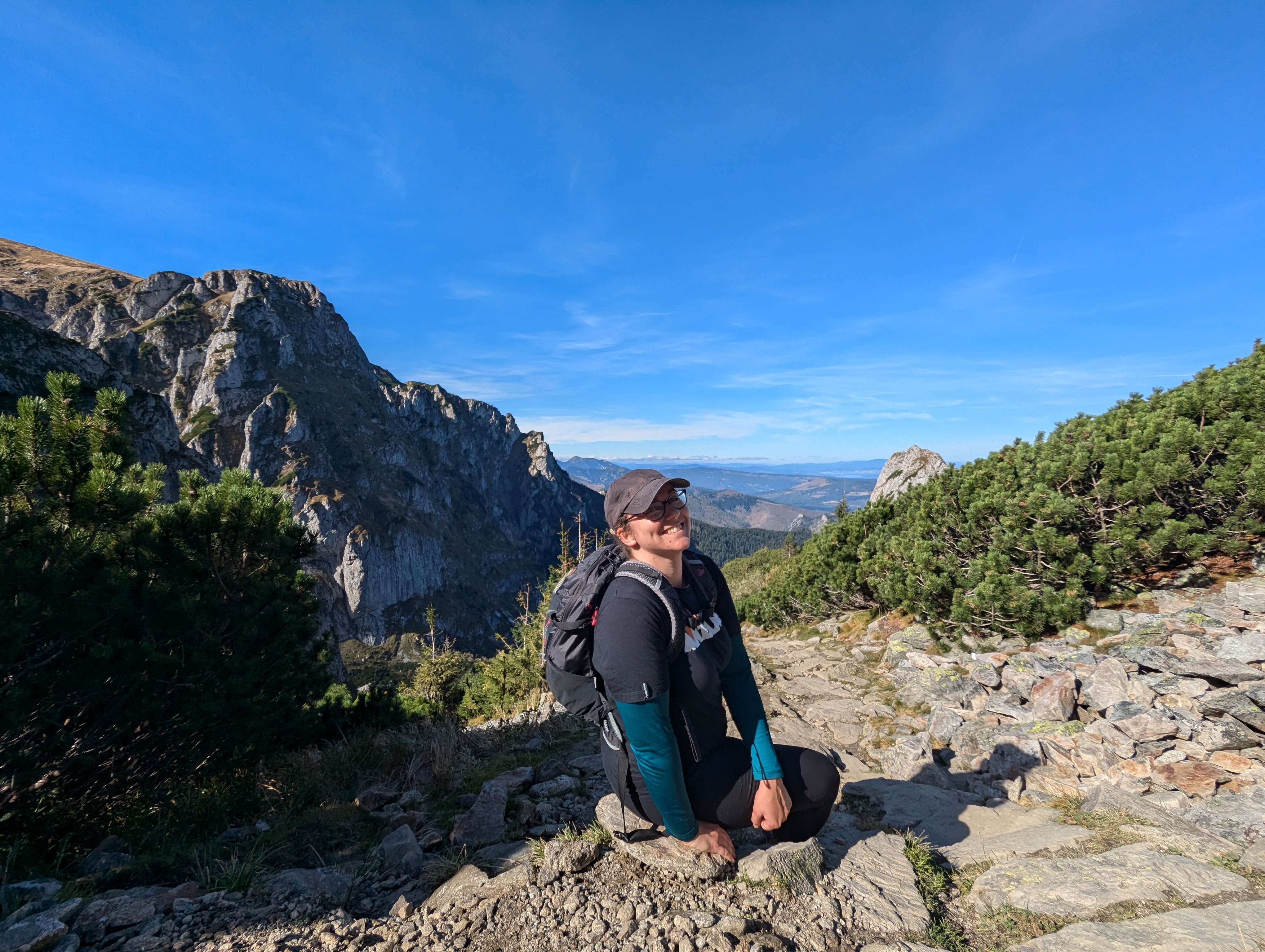
The accomodation provide a continental breakfast with a mountain view. Soft, little white bread rolls from the shop down the road. Cold cuts, vegetables, a hard boiled egg. Before we head out I spend a significant amount of time looking at a weather warning for wind. I eventually establish it doesn’t apply until the evening. The sky is blue, the sun just creeping over the peaks. We set out in to the cold morning air, walking up the road to the car park. There’s a cabin at the edge of the High Tatras National Park. There’s a charge to get in! I’ve mixed feelings on this. If it pays for support, and infrastructure, and mountains rescue then great, but the outdoors really should be free. We pick up the trail, passing through the autumn colour in the trees. The route follows a fine wide track, a white water stream rushing away along side. I can’t tell you precisely when the stupid grin settled on my face. Was it here? At the very beginning? Probably. We exchanged tales of horse rides and hikes until we reach a meadow and the first sight of the high rock walls. There are only a few people about, which is a perk of setting off from out of town. The trail heads up. Climbing, always climbing. Up, up and up. We make good time to the saddle below the summit of Giewont. The view across the Tatras is suitably breath taking. I let out a barely audible “epic”. Truly, it is. Time for a snack.
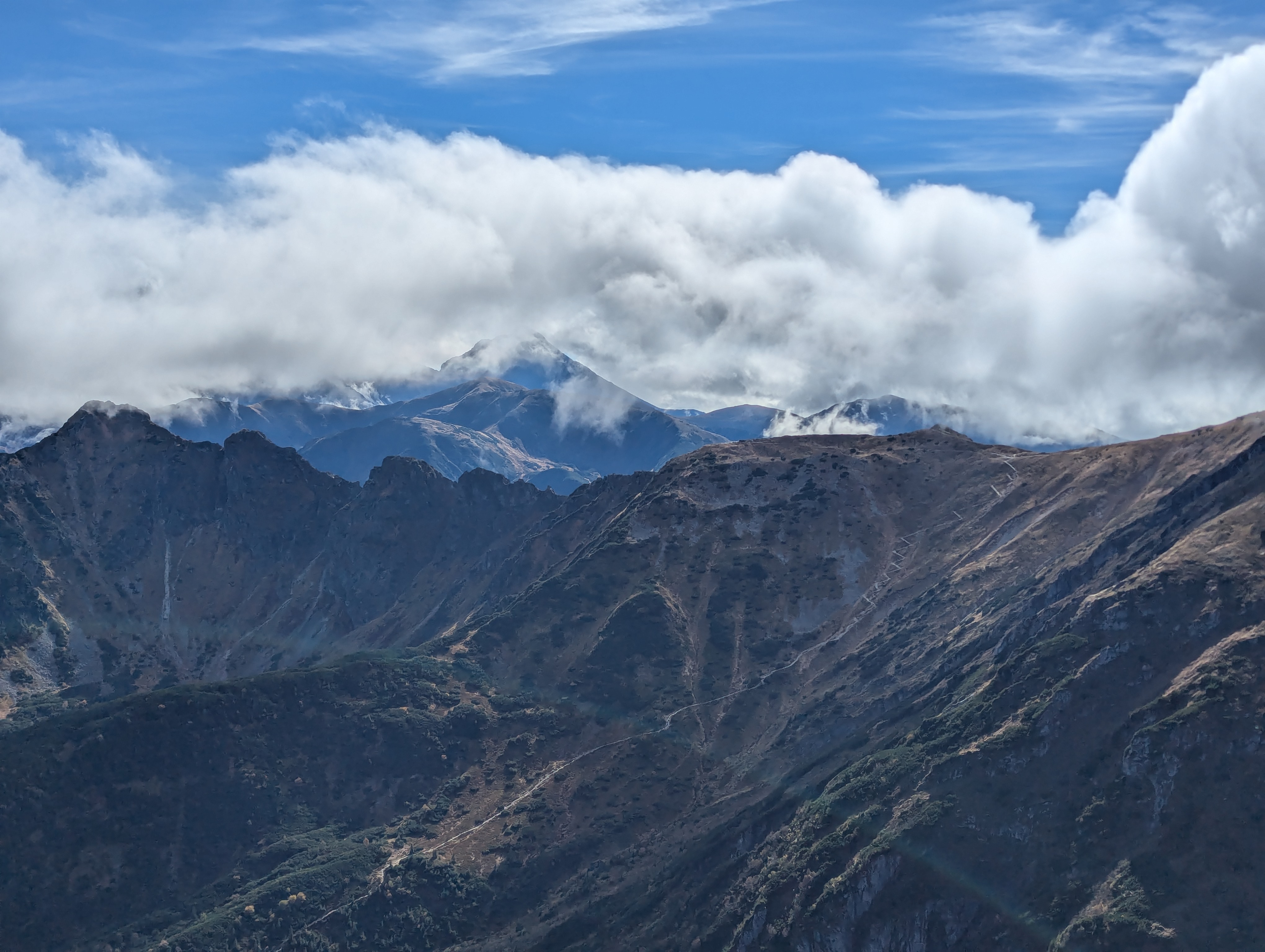
Summiting Giewont is what most people come and do in Zakopane. I’d seen photos online of queues, but looking up at the cross the traffic is light and moving freely. I spent most of our break munching a sandwich, looking South, anxious about the cloud billowing on the peaks. Rachael asks if I want to go up and I think we should, so we do. The path splits in to a one way circuit to the summit. Fresh chains have been drilled in to the rock to aid in hauling ourselves up over the polished rock slipping under foot. I’m glad we’re not here in peak season. Doing this under pressure would be a lot less enjoyable. The wind is huffing and chuffing and I feel uncomfortably exposed at the summit, overlooking Zakopane. I stop just long enough to ask if you can see where we live from here, and I imagine we probably can. We tap the cross, and I think Rachael is perhaps a little disappointed that I’m overly keen to get down. The descent is long, over boulder paved trail. Knees flexing in every direction. The mountain hostel is under construction. What isn’t? I was hoping for a cup of hot beetroot soup but settle for a Lipton tea. The weather really feels like it’s coming in. Black skies swallow the peaks. Moisture rides the wind. Up ahead though, things are still clear, crisp and blue. We look for fresh, mountain smoked sheep’s cheese but there’s no sheep and no shepherd. A plod back down the trail to a very different, very busy trail head. There’s an information board that catches my eyes. The name of the wind; the foehn effect. Only here they call it halny. It’s what I’ve been keeping an eye on. The rain shadow of the mountains has kept us try, but the wind is coming for us. We squeeze on one, then another bus, and arrive home. Still in view of the Giewont Cross.

Clouds lay thick on the High Tatras, bubbling like steam over a cauldron. We’ve already settled for a quiet day, a relaxing day. We catch a midmorning bus into town and walk to the Thermy Zakopane. Rachael had wanted to visit a complex out of town but they’re closed for all of October. Getting in is tricky, as we need towels. No outdoor footwear is permitted. My Polish is still zero, and anxiety rising. I have no idea what is going on. Rachael does a good job and we get towels and it’s apparently fine to go bare foot. Once we’re in, the surprise is going upstairs to the pool. Outside, in the first spa pool it all makes sense. The moody mountains are in clear unobstructed view. We move from jet to fountain, pool to pool. The weather is better than predicted and I’m slightly worried I’ll end up adding “Poland in October” to my list of places I’ve gotten sunburn where it really shouldn’t have been possible to get sunburn. We sit and watch the end of one slide for a bit, trying to make sense of the times being displayed. All time fastest, today’s fastest, and current time. If you come out slower than today’s time you get a thumbs down flash on the screen. We never see a thumbs up. Time to try for ourselves. The stairs up trigger pain in the legs for both of us. Pitch black in the tube, then stars, then the roar of water as you splash back out in to the pool. The thumb is gone by the time you look back. Too slow. We end up having a go on each of the four slides, and a repeat on the good ones. The rapids are not, making me wishful for Coral Reef in Bracknell. I’m sure the pull of water there would suck you in, and if you didn’t time your exit right you’d get trapped. We spend more time here than I imagined we would. There’s no queues, no wait. Lunchtime on a Wednesday was a good time to come.

We mooch for the afternoon, around the chalets of town in various stages of disrepair. Then we find some food before mooching some more. Rachael spots one of the cheese stalls on the high street has a grill, so we grab a slice of fried oscypek with cranberry sauce. A service is on in church so we back out quickly. There’s a market of somehow even more tat opposite the high street. Stores next to each other all selling the local smoked sheep’s cheese. How is anyone making any money? Rachael looks at some socks, and a bag and I quickly realise how people are making money. We look to wander through a cemetery but a man’s at the gate taking an entrance fee. That can’t be much worse than charging for toilets? Rachael guides us to another traditional restaurant for an early dinner. We share a platter of cheeses, with plums wrapped in bacon, and then two plates of pierogies. Again, it’s too much food and I need a lie down.

The first bus of the day is someone’s Mercedes Sprinter. It feels odd opening a van door for public transport. The driver is enjoying the Polish folk music on the radio. We swap busses at the train station, the radio now a lot more party bus. The forecast feels misguided, the threat is overcast, probably rain. The only clouds in sight are sitting over the peaks. The bus follows a sweeping mountain road through pine and beech and trees I don’t know what to call. The journey is filled with flashes of gold and red. The road carries us up in to the mountains and delivers us at a carpark. Another entry fee. The trail is a tarmaced road. Easy going and accessible. The busiest place we’ve been. Families, school groups, pushchairs. There’s an option for a horse drawn cart to carry you most of the way. Fairy tale red cap toadstools pop up along the track’s verge. Early in the day Rachael spots a pine marten or a stoat. This tiny creature running across the trail, it pauses for a second to look at us, terrified. Then it’s gone.
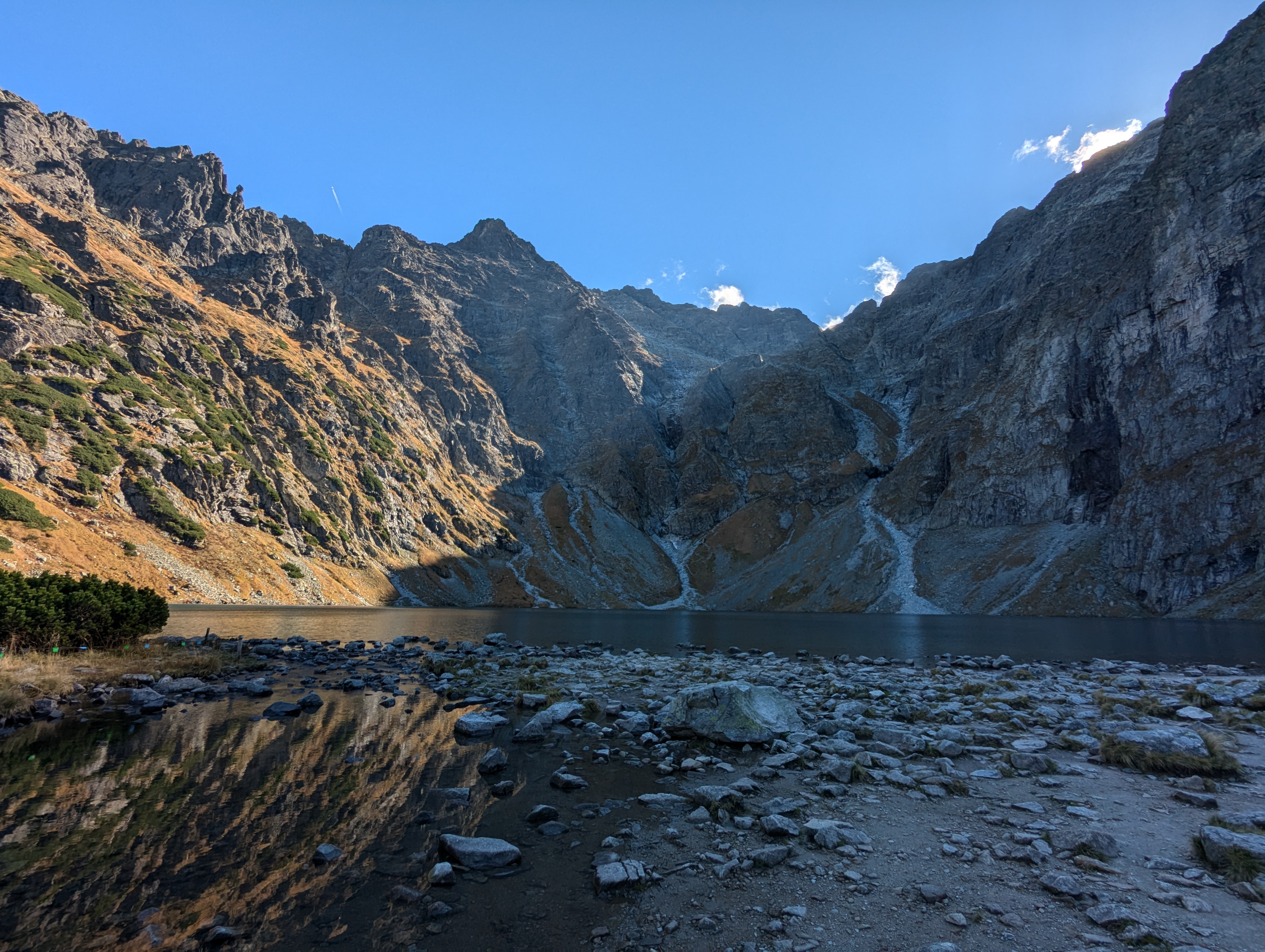
The mountains are huge. Despite having driven maybe halfway up it’s still a two hour steady ascent to Morskie Oko. We weave through forest, abandoning the switchbacks for a straight blast up. The first sight of water is a deep green pool, clearest I’ve seen in some time. I’d stop you, to check, have you seen it, if you were there. We climb once more to the mountain hut and the view of the lake. Morskie Oko translates as Eye or the Sea and it is a beautiful spot. The sun is out, against all predictions, and it’s actually hard to see what we’re looking at. A massive bowl full of ice melt. There’s no swimming, no feeding the ducks, no feeding the fish, no throwing coins. Rachael and I go around the lake edge, crowd melting away the further we get from the trail head. The light occasionally the colour of magic. We stop to take a thousand photos of the same thing, in slightly different shadows. There are crowds again at the vertical climb up to the second, smaller lake; Czarny Staw. This is harder work. Another vertical punch straight up. The sun is so bright still, but soon sets behind the mountains, at 1pm. The trails beyond switch back up to various saddles, some look achievable, some look intimidating. People pass through with helmets strapped to their packs. Fair enough. We finish off the lake, passing over the tails of waterfalls. Rachael buys us tea and a slice of apple cake. We try to eat outside but the wind has picked up. I’m waiting for our snack to be blown away. We rush back inside the mountain hut to find chaos; people not quite but nearly fighting for a table. We managed to slip on the end of someone’s table and eat our cake. I realise my down jacket must have fallen out. Panic, and the self-loathing of the idiot I can be kicks in. I rush back out and I’m lucky to find it still on the patio. Time to go. We spot both a northern nutcracker and then later a jay, really the only birds we’ve gotten close to. Downhill is slow and steady. We’re in no rush and are regularly overtaken by the horse carts and those more desperate to get down.
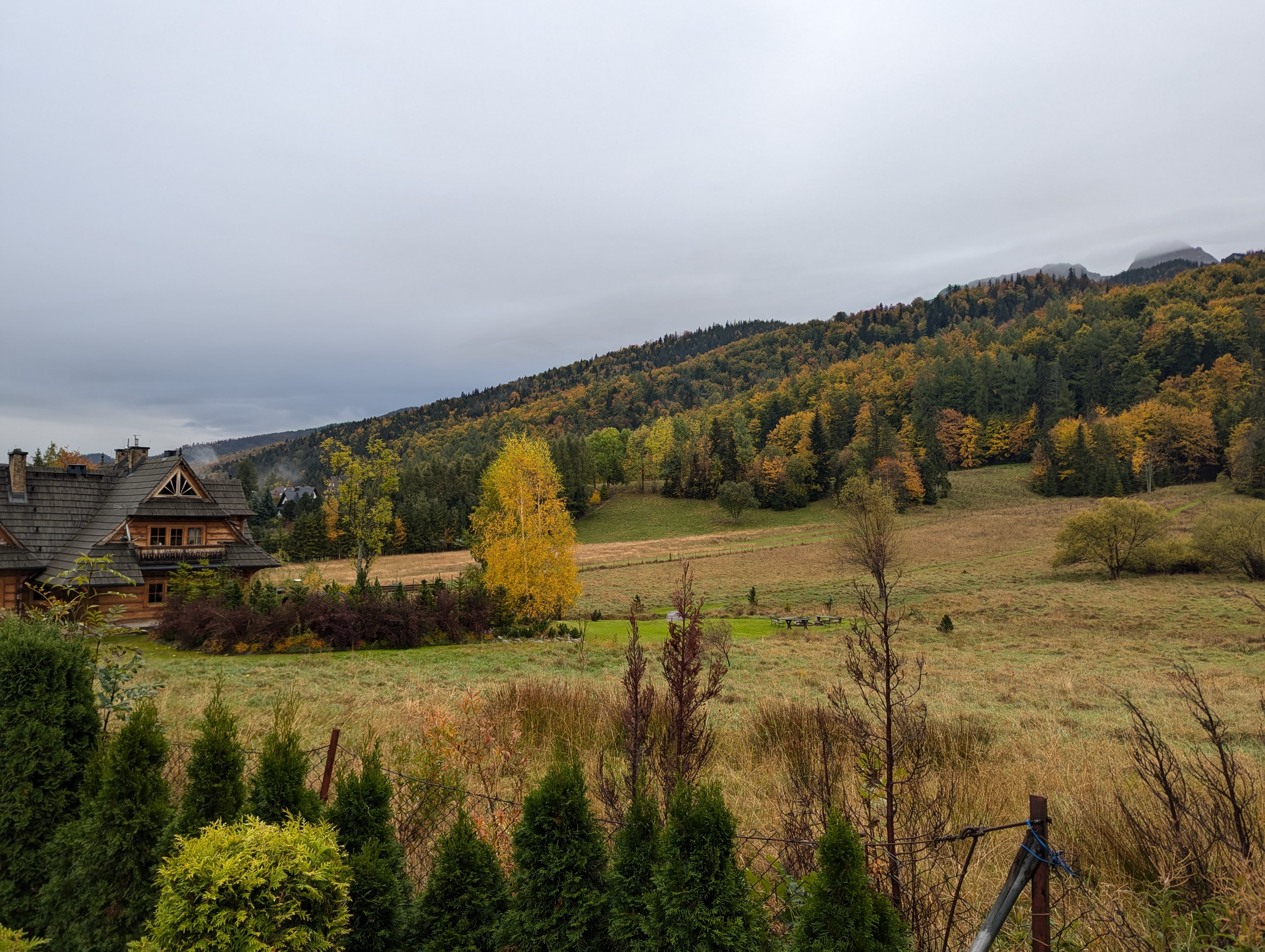
Clouds billow like smoke over ridge lines. The trees seem to have taken on more colour while we’ve been here. Rain falls and we shelter in a cafe while waiting for the bus back to Krakow. More bagels are purchased, poppy seed and cheese. The sky clears as we leave the High Tatras mountains behind. Rolling green and now yellow hills. All the villages out of Zakopane seem to cater to winter tourism. Villas and ski shops abound. We return to almost the same apartment in Krakow. An apocalypse of crows move across the sky to roost in the park of the old walls. There’s a heavy police presence in the city, which I assume was football related, but Rachael later learns was due to an EU summit. More Polish food follows; borscht, a beer. A sausage and a shot. Cherry flavour. Tastes too much like manufactured flavour to be truly enjoyable. We wander around the square, catching the bugle off the basilica at whatever o’clock it might be. There are still tat shop opens and we look at paper-cut cockerels, painted wooden birds, impressionist water colours of the city, and even more ugly magnets.
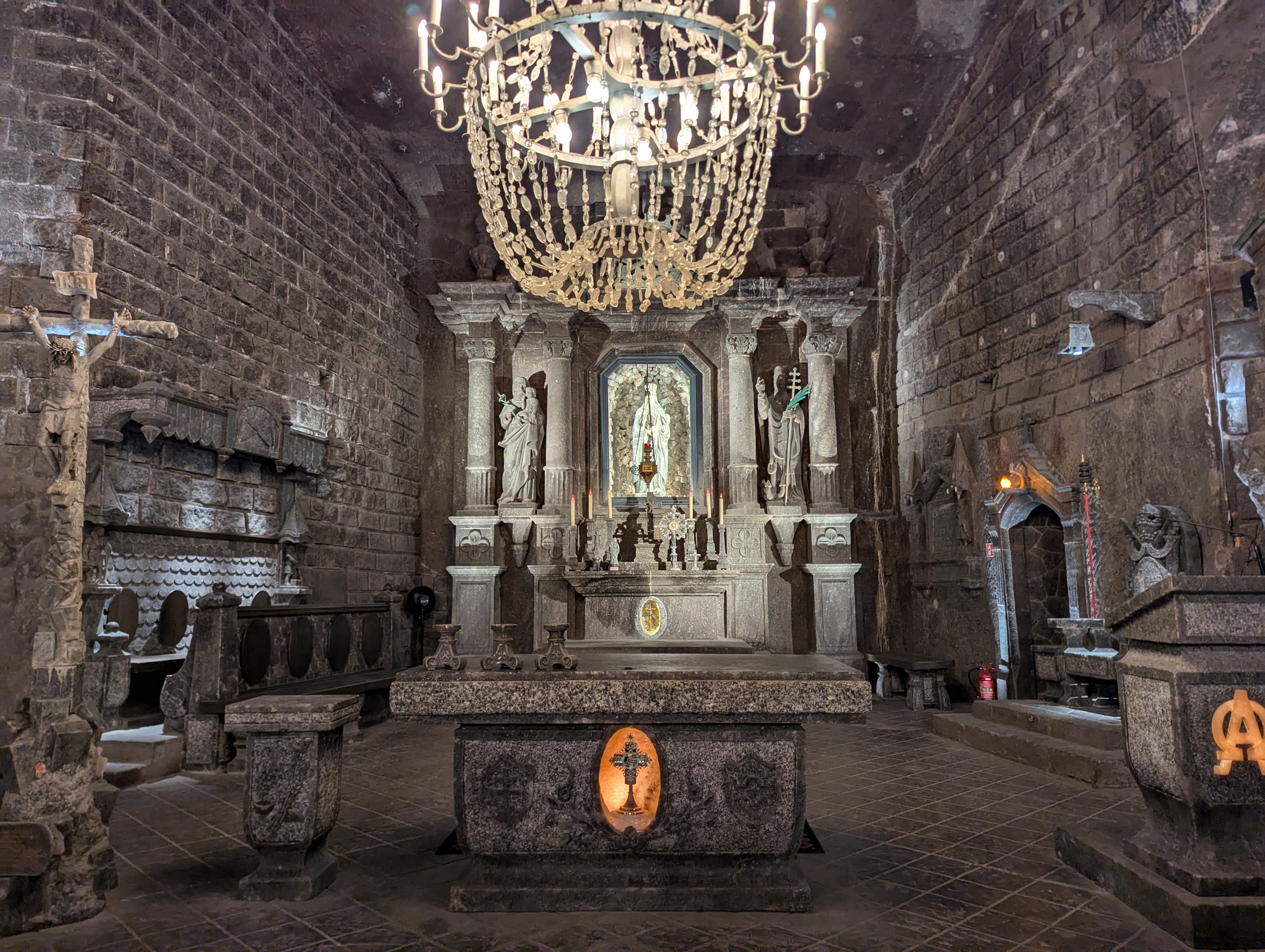
Our final day leads us out to the Wieliczka Salt Mine. Rachael and I have both been to Auschwitz on previous trips, and while it’s one of the most memorable things I’ve ever done I’ve no desire to go back. We bus out again. Rachael’s local knowledge and confidence getting us around at a cut price. The mine complex isn’t far away, and above ground seems huge, which is nothing compared to the almost 300km of tunnels below the surface. We’re funnelled into a building and then into an airlock which smells like cured ham. The descent feels like a mirror trick, the 50 flights of stairs looks infinite. In the first chamber, Rachael’s more excited than I am to find the first statue carved out of salt is Copernicus himself. Evalina, our guide, proves that he is made of salt by running a torch along the edge. The light passes through. Cauliflower and spaghetti formations of salt drip through the ceilings. I’m not sure if Evalina is joking each time she suggests licking the walls, or sampling the brine. I am tempted. We’re led down various tunnels, through chambers of varying sizes, where characters have been carved, old staircases remain. The main attraction is the St Kinga Chapel, which has impressive carvings, including a replica of the Last Supper, and chandeliers made out of salt crystals. For me the highlight was the wooden support structure of the Drozdowice chamber which doesn’t feel real. How could humans have built this when we now can’t even manage a train line? It’s a mad place. Brine lakes filling empty chambers. There’s a tunnel in one of them, and once you could get a ferry between chambers but of course someone had to ruin it for the rest of us by going and getting killed. I stop to use the toilets and break my own personal record for deepest underground wee. The exit is delivered entirely in Polish, so we follow a group in the hope we get out. We’re squeezed into a rickety, old and authentic lift and blasted back to the surface.
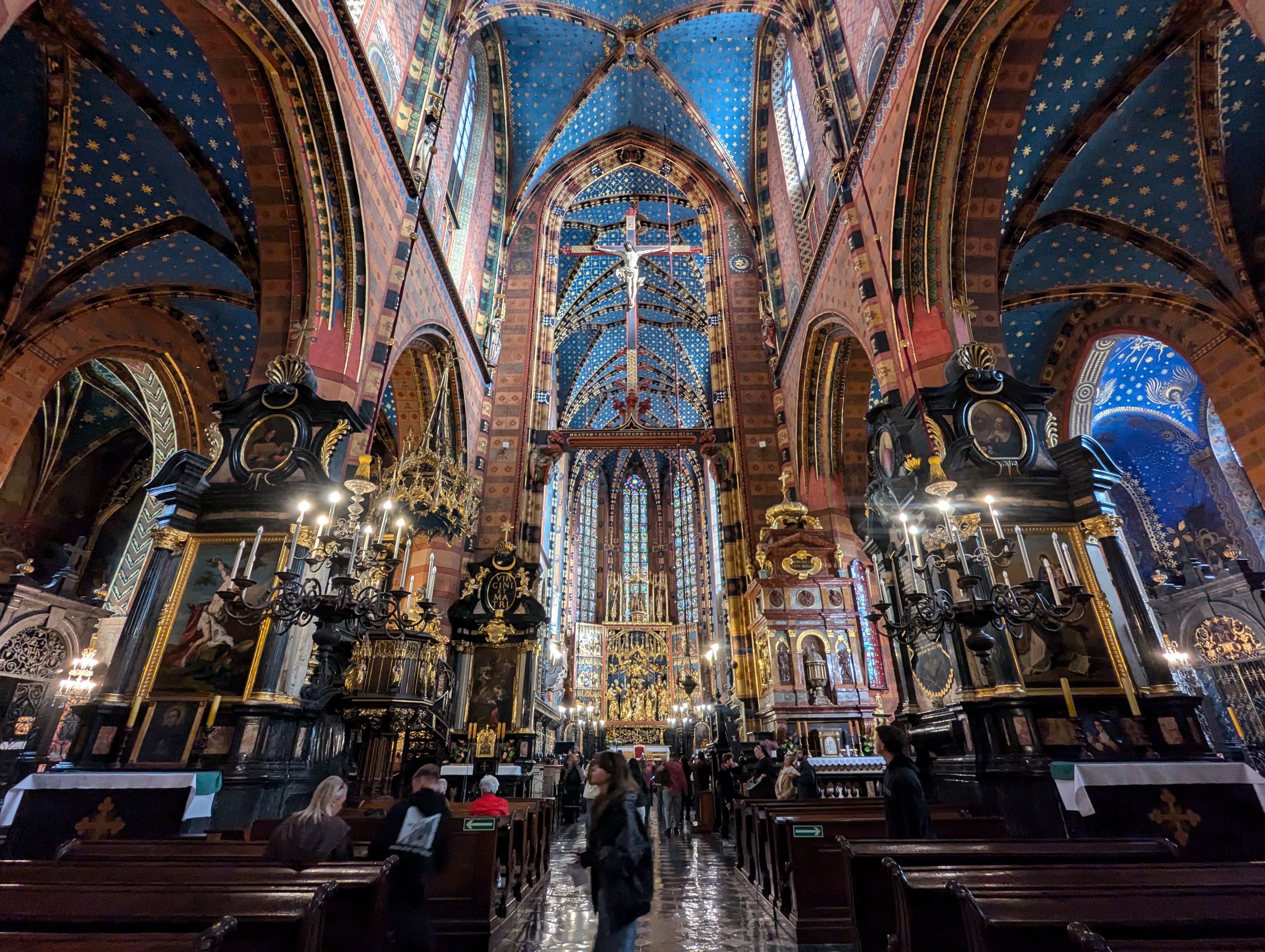
The afternoon sees us return to the Basilica of St Mary, which has been finished and had the scaffolding taken down while we’ve been away. The tower is still closed, but Rachael has convinced me it’s worth paying the 15 zloty to go in. Like most of the other churches we’ve walked in, the interior is obscene. The walls are decorated, the windows, are stained, there are paintings, and all the carvings are covered in gold. While I’m thinking about what would be easiest to pillage (a candle?), Rachael spends an age sitting in the pews reading up facts. The best one is about the bugle played every hour on the hour. It’s a memorial to the bugle player who warned the city of impending invasion from the Mongols in the 13th century. His tune was cut short by an arrow in the neck, probably. In the carving behind the altar onee of the three wise men is black, which is unusual. Especially seeing as Mary looks like Queen Elizabeth I. White as a ghost with a shock of red hair. The final dinner of the trip sees me finally beaten by Polish portions. I probably didn’t need to start with another borscht but I do love a hot beetroot soup. The bigos stew comes out in a bowl fit to serve at least three, plus half a loaf bread. I give it a good seeing to but for the first time in a long time I’m leaving food to return to the kitchen. Rachael meanwhile has demolished another selection of pierogies. We make a final lap of the square, looking in yet more gift shops.
The restaurant at the airport for breakfast has a final surprise. A robot waitress, though I’m not sure if that’s misgendering the trolley. It has cat ears, it’s wearing a bandana and a cowboy hat. Everyone is very confused. The robot gets slowed up amongst our bags, again near a human waitress’s trolley and Rachael can’t help but wonder how much worse this is. I’m inclined to agree. A human brings us our breakfast and we’re thankful. A short walk through the duty free and another long wait at a gate before we board the plane. Separated again, another middle seat. I lose myself in my book, looking out the window to see a cargo ship sits off the East coast of England. The beach comes, then the vast flats of Anglia. Brown fields, nothing growing. An absence of trees. The rumble of rubber on concrete. Home.
 I Don't Have The Map